Home › Daily True or False
100 True or False Questions With Answers + How to Host
A true-or-false quiz is the simplest party quiz there is: the host reads one statement and everyone decides true or false. Here's how to run the elimination version, settle the arguments, and 100 statements with answers and a one-line why.
- Players
- 5 to several hundred · 2 to 4 play for points instead of elimination
- Time
- 40 seconds to a minute per statement · 15 statements take 10–15 minutes
- You need
- A list of statements · a line on the floor (tape or rope) or a true/false card each
- Questions
- 100 on this page (50 true, 50 false), each with the answer and a one-line why
- Good for
- Classrooms · company field days and parties · family gatherings · camps
Ask a room “true or false: an octopus has three hearts” and you can watch the whole group think. Most people hesitate, a few commit loudly, and someone always switches at the last second. (It’s true: two hearts pump blood through the gills, one pumps it around the body.)
That half-second of doubt is the entire game, and it scales absurdly well. The host reads one statement; five people or two hundred answer at the same moment, so a round takes the same time no matter how big the crowd gets. That’s why it turns up at school assemblies, summer camps and company field days. The catch is refereeing: skip the rules up front and you’ll hear “my foot wasn’t on the line!” and “well, technically…” before the fifth statement. Most of this page is about preventing exactly those two arguments.
Three ways to answer
The game is the same; the way people show their answer changes the mood. Pick by space and headcount.
| Format | How it works | Best for |
|---|---|---|
| Walk to a side | A line on the floor splits the room: true on the left, false on the right. Players walk to their side | Gyms, halls, big classrooms, 20+ people |
| Arm signals | Arms in a circle over your head for true, crossed in front of your chest for false | Fixed seats: classrooms, meeting rooms, restaurants |
| Cards | Fold a sheet of paper in half, write a big T on one side and F on the other, hold it up | Quiet rooms, video calls, large halls where the back row needs to be seen |
Walking to a side is the most fun and the most chaotic. People follow their friends, or dash across the line at the last second, and that bluffing becomes part of the game. If you’d rather test knowledge than nerve, use signals or cards and have everyone reveal at once on “three!” A simultaneous reveal leaves no time to copy.
Running it, step by step
One host is enough. Past about 30 players, add a helper to judge who’s on which side.
- Explain the rules in 30 seconds How to answer, that wrong answers sit down, what happens if everyone’s wrong, and when the comeback round happens.
- Ask a practice statement Something everyone gets, like “The sun rises in the east.” It’s for checking the signals, and nobody goes out on it.
- Read every statement twice The back row always misses the first reading.
- Give a clock Five seconds for signals and cards, ten for walking. Count down out loud: “Five, four, three, two, one, freeze!”
- Freeze means freeze Anyone moving after the call, standing on the line or straddling both sides counts as wrong.
- Reveal with a pause Say “The answer is…”, wait two seconds, give it, then add the one-line why. The why is where the “no way!” comes from.
- Wrong answers sit, and you announce the count “Twelve left!” keeps everyone tracking the race.
Budget 40 seconds to a minute per statement: about ten seconds for reading twice, five to ten to decide, fifteen to twenty for the reveal and the why, and ten for people to sit down. Fifteen statements run 10 to 15 minutes; walking to sides adds a little.
How many statements for how many people
Imagine everyone is guessing blind. Then on average half of them survive each statement: 30 players become 15, then 7.5, and after five statements 30 ÷ 32 ≈ 0.9 people are expected to be left. So the number of statements needed for the expected count to drop below one is simply how many times you can halve the group.
| Players | Blind guessing: statements until fewer than 1 is expected | Prepare (plus 5 for a final) |
|---|---|---|
| 10 | 4 | 10 |
| 30 | 5 | 15 |
| 50 | 6 | 15–20 |
| 100 | 7 | 20 |
| 200 | 8 | 25 |
In real life people know some answers, and easy statements knock almost nobody out, so prepare two or three times the blind number. Leftover statements cost nothing. Running dry with five people still standing is how a host breaks into a sweat.
The rules to announce before you start
The arguments in a true-or-false quiz almost always come from the same few places. Say these up front and most of them never happen.
- If everyone left is wrong, everyone stays That statement simply doesn’t count.
- Decide how many winners Last one standing is the classic, but with three prizes, “we stop at three” is cleaner.
- Sudden death at three Once three or fewer remain, every statement is a final: if only one gets it right, they win; if they all miss, they all stay.
- Out of statements? Number question If several are still standing when your list runs out, everyone writes a number and the closest wins. For example: “On average, how many kilometers is it from Earth to the Moon?” (about 384,400 km, or 238,900 miles).
- Phones away Anyone caught searching is out on that statement.
- One challenge per statement, before the next one is read Re-arguing statement four after statement nine stalls everything.
- Latecomers start on the bench They play along from their seats and can come in through the comeback round. If the game is nearly over, they join the next one from the start.
One comeback round, at a set moment
If people sit out too long, the whole room cools off, so one comeback round is worth it. A good moment is when the players still standing drop below a quarter of the starting group. Everyone who’s out stands up for one statement; whoever gets it right is back in. Make that statement a bit harder than average, or nearly everyone returns and you’ve restarted the game. With young kids, let luck decide instead: everyone who’s out plays rock-paper-scissors against the host, and the winners come back.
A good statement is clearly true or clearly false
The most common mistake is a statement that’s true or false “depending on how you look at it.” The host meant true, someone in the second row says “well, technically…”, and suddenly you’re refereeing a debate. Putting the measuring stick inside the sentence fixes most of these.
| Shaky statement | Why it’s shaky | Fixed (answer) |
|---|---|---|
| Mount Everest is the tallest mountain in the world | Measured from base to peak, Mauna Kea in Hawaii is taller | Measured by height above sea level, Everest is the tallest mountain in the world (true) |
| The Sahara is the world’s largest desert | If a desert is any land with very little precipitation, Antarctica is bigger | The Sahara is the world’s largest hot desert (true) |
| A day on Venus is longer than its year | Sunrise to sunrise on Venus is about 117 Earth days, shorter than its 225-day year | Venus takes longer to spin once on its axis than to orbit the Sun once (true) |
| Water boils at 100°C | On a high mountain the air pressure is lower, so it boils at a lower temperature | At sea-level pressure, water boils at about 100°C (true) |
A few more habits help.
- Watch out for “always”, “never” and “all” Those words usually signal false, so sharp players can answer without knowing anything. If you use them, use them in some true statements too.
- No double negatives “It is not untrue that…” ties brains in knots.
- Roughly half true, half false But don’t alternate true, false, true, false, or people will read the pattern. Shuffle the order and only keep the totals balanced.
- Surprising truths and believable myths win Statements that sound impossible but are true, and ones everyone believes but are false, swing the room. Save the obvious ones for the practice round and the first two.
- Skip facts that change Population rankings, current records and people in office go stale.
- Write the one-line why first If you can’t explain the answer in one line, the statement is probably ambiguous.
Kids, adults and mixed crowds
With primary-school kids, keep the bench time short. Hold a comeback every three statements, or drop elimination and have them count correct answers on their fingers. Pick topics they can picture, like animals, space and their own bodies, and ask “why do you think?” before you reveal. It doubles as a great lesson opener.
With adults, myth-busting statements get the biggest reactions. At a company event, split into teams and compare how many each team has left standing; spectators turn into a cheering section. If you mix in questions about the company, make sure they aren’t ones only one department could answer.
With mixed ages, it’s fine to vary the difficulty. Announce “this one’s a kids’ question!” now and then and the children stay in to the end, while a few parents fall to the grown-up ones.
With two or three people, elimination doesn’t mean much. One person reads five statements, the others count their correct answers, then you rotate the reader. A fun variation for two: each writes true-or-false statements about themselves (“I’ve never been abroad”) and the other guesses.
With more than 100 people, use a microphone and prefer arm signals or cards over walking. Put a helper in each section who only reports numbers to the host (“seven left in section B”) so the pace never stalls.
When true or false gets too easy, the four-option trivia questions make a good second round, and the pun riddles are perfect for winding down. More games for the same room are in 15 indoor group games.
100 true-or-false questions with answers
Cover the answer column and read them out. The first 15 are easy enough for kids, so they make good practice statements or openers; the rest are grouped by topic. Exactly 50 are true and 50 are false, so a game picked from anywhere in the list stays roughly balanced.
Easy ones (kids too)
| Statement | Answer | Why |
|---|---|---|
| Spiders are insects | False | Insects have six legs; spiders have eight |
| The Moon makes its own light | False | It reflects sunlight |
| Bats are birds | False | They give birth and feed their young milk, so they’re mammals |
| Ice floats on water | True | Water expands when it freezes, so ice is lighter than the same amount of liquid water |
| An octopus has eight arms | True | That’s the “octo” in octopus: it means eight |
| All birds lay eggs | True | Every bird, from ostriches to penguins, hatches from an egg |
| Clouds are made of smoke | False | They’re made of tiny water droplets or ice crystals |
| To see a rainbow, the Sun has to be behind you | True | Sunlight has to come from behind you and bounce back out of the raindrops in front of you |
| Butterflies are insects | True | Six legs and a body in three parts: head, thorax and abdomen |
| Plants make their own food from sunlight | True | Leaves turn sunlight, water and carbon dioxide into sugar; that’s photosynthesis |
| Earth goes around the Sun | True | One trip around takes about a year |
| A shooting star is a star falling | False | It’s a bit of space rock or dust burning up in the air |
| Penguins can fly through the air | False | Their wings work like flippers, so they “fly” underwater instead |
| Salt water freezes more easily than fresh water | False | Salt water has to get colder than 0°C before it freezes |
| Chickens can’t fly at all | False | Not far, but they can flutter up onto fences and branches |
Animals
| Statement | Answer | Why |
|---|---|---|
| Dolphins sleep with one half of the brain at a time | True | They have to keep surfacing to breathe, so half the brain stays awake |
| Bats are blind | False | All bats can see; many also use echolocation |
| Ostriches bury their heads in the sand when scared | False | They run, or lie flat on the ground to hide |
| A koala is a kind of bear | False | It’s a marsupial that raises its young in a pouch, like a kangaroo |
| A polar bear’s skin is black | True | The fur looks white, but the skin underneath is black |
| Flamingos are pink from the day they hatch | False | Chicks are grayish; pigments in their food turn them pink as they grow |
| Jellyfish have no brain | True | A net of nerves spread through the body does the job instead |
| Honeybees dance to tell each other where flowers are | True | The direction and length of the figure-eight waggle dance give direction and distance |
| A camel’s hump stores water | False | It stores fat, which the camel burns for energy when food is scarce |
| Bulls get angry when they see red | False | Cattle can’t tell red apart well; in a bullfight it’s the cape’s movement they charge at |
| Cats can’t taste sweetness | True | The gene for the sweet taste receptor is broken in cats, so the signal never fires |
| A shark’s skeleton is made of cartilage, not bone | True | The same flexible stuff as the tip of your nose |
| Hummingbirds can fly backward | True | They beat their wings in a figure eight, which lets them hover and reverse |
| A turtle can climb out of its shell | False | The shell is fused to its ribs and spine; it’s part of the skeleton |
| No two zebras have the same stripes | True | Like fingerprints, every zebra’s pattern is unique |
| Wild penguins live in the Arctic too | False | Wild penguins live almost entirely in the Southern Hemisphere, none in the Arctic |
| Giant pandas are bears | True | They mostly eat bamboo, but they belong to the bear family |
| Frogs can breathe through their skin | True | Oxygen passes through their moist skin, which is why drying out is dangerous for them |
| Owls can turn their heads a full 360 degrees | False | They can turn about 270 degrees, not all the way around |
| A whale shark is a fish, not a whale | True | It’s a shark that breathes through gills, and the largest living fish |
The human body
| Statement | Answer | Why |
|---|---|---|
| Newborn babies have more bones than adults | True | Babies start with close to 300; many fuse as they grow, leaving adults with 206 |
| People only use 10% of their brains | False | Brain scans show nearly every part of the brain at work over a day |
| Different parts of the tongue taste different flavors | False | Every part of the tongue can taste sweet, salty, sour, bitter and umami |
| Blood in your veins is blue | False | It’s dark red; veins only look blue because of how light passes through skin |
| Fingernails grow faster than toenails | True | Roughly twice as fast |
| Your skin is your body’s largest organ | True | An adult’s skin covers roughly 1.5 to 2 square meters |
| Tooth enamel is the hardest substance in the human body | True | It’s harder than bone |
| Your heart stops when you sneeze | False | Chest pressure can nudge the rhythm briefly, but the heart keeps beating |
| Swallowed gum stays in your stomach for seven years | False | It isn’t digested, but it passes through like anything else within days |
| You’re slightly shorter in the evening than in the morning | True | The discs in your spine compress during the day; you lose around a centimeter |
| Your eyeballs never grow after birth | False | They do grow, noticeably, until adulthood |
| Reading in dim light permanently damages your eyes | False | It can tire your eyes, but it doesn’t cause lasting damage |
| Hair and nails keep growing after death | False | The skin dries and shrinks back, which only makes them look longer |
Space
| Statement | Answer | Why |
|---|---|---|
| The Moon drifts a little farther from Earth every year | True | About 3.8 cm a year |
| The Great Wall of China is visible from the Moon with the naked eye | False | From the Moon you can make out continents and oceans, not buildings |
| Venus is the hottest planet in the solar system | True | Hotter than Mercury, which is closer to the Sun, because its thick carbon dioxide air traps heat |
| We always see the same side of the Moon from Earth | True | The Moon spins once in exactly the time it takes to orbit Earth once |
| Mars looks red because of rust | True | Its soil and dust are full of iron oxide |
| Saturn is the only planet with rings | False | Jupiter, Uranus and Neptune have rings too; Saturn’s are just the biggest and brightest |
| The North Star is the brightest star in the night sky | False | That’s Sirius. Polaris is famous because it barely moves, not because it’s bright |
| Sunlight takes about eight minutes to reach Earth | True | The light you see left the Sun about 8 minutes 20 seconds ago |
| The Moon has almost no atmosphere | True | That’s why its sky is black even in daytime |
| Astronauts get slightly taller in space | True | Without gravity squeezing the spine they can grow up to 3%, then shrink back on Earth |
| Seasons happen because Earth gets closer to and farther from the Sun | False | They come from Earth’s tilted axis; Earth is actually closest to the Sun in northern winter |
| Neptune is the farthest planet from the Sun | True | It’s eighth of the eight planets |
| Jupiter’s Great Red Spot is a giant storm | True | A storm wider than Earth, watched continuously since the 1830s |
Earth and nature
| Statement | Answer | Why |
|---|---|---|
| Lightning never strikes the same place twice | False | Tall buildings are hit again and again; the Empire State Building averages about 23 strikes a year |
| Antarctica is colder than the Arctic | True | Antarctica is a high, ice-covered continent; the Arctic is ice floating on a relatively warm ocean |
| The Dead Sea is several times saltier than the ocean | True | Its salinity tops 30%, close to ten times the ocean’s 3.5%, which is why you float |
| Most of Earth’s surface is ocean | True | About 71% of the surface is covered by water |
| You see lightning before you hear thunder | True | Light travels far faster than sound |
| Deserts stay hot all night | False | Dry, clear air lets heat escape quickly, so desert nights can get cold |
| Volcanoes only exist on land | False | Many are on the seafloor; Hawaii itself was built by undersea volcanoes |
| Each step up in earthquake magnitude releases about 32 times more energy | True | A magnitude 6 releases roughly 32 times the energy of a magnitude 5 |
| Glaciers are made of frozen seawater | False | They’re compacted snow, so they’re freshwater ice |
| The sky is blue because it reflects the ocean | False | Air scatters blue sunlight more than other colors, so blue comes from every direction |
| In temperate climates, a tree usually adds one growth ring a year | True | Fast spring growth and slow late-season growth make one ring together |
| Bamboo is a grass, not a tree | True | It belongs to the grass family, like rice and wheat |
| Bananas grow on trees | False | The “trunk” is tightly rolled leaves; a banana plant is a giant herb |
Science and everyday life
| Statement | Answer | Why |
|---|---|---|
| Diamonds and pencil graphite are made of the same element | True | Both are pure carbon, just with the atoms arranged differently |
| Gold sticks to a magnet | False | Pure gold isn’t attracted to magnets; if it sticks, it’s mixed with another metal |
| Water is densest at about 4°C | True | That’s why lakes freeze from the top down while the bottom stays around 4°C |
| Old windows are thicker at the bottom because glass slowly flows | False | Old panes were uneven to begin with, and builders often set the thick edge at the bottom |
| A lightning strike victim stays electrified, so touching them is dangerous | False | The body doesn’t hold a charge; you can help them right away |
| Microwaves cook food from the inside out | False | In thick food the microwaves heat the outer layers first; the center cooks as that heat moves inward |
| Without air resistance, a heavy ball and a light ball dropped together land together | True | Everything falls at the same rate; an astronaut showed it on the Moon with a hammer and a feather |
| Sound travels faster in water than in air | True | About 1,500 m per second in water versus about 340 in air |
| A plane’s black box is black | False | It’s bright orange so searchers can spot it in wreckage |
| Pencils contain lead | False | The “lead” is graphite mixed with clay; there’s no lead in it |
| Falling raindrops are shaped like teardrops | False | Small drops are round; bigger ones get flattened underneath by the air, like a hamburger bun |
| The air you breathe out still contains oxygen | True | You only use part of it; exhaled air is still about 16% oxygen, which is why rescue breaths work |
Food
| Statement | Answer | Why |
|---|---|---|
| Botanically, a banana is a berry | True | The whole fruit develops from a single flower’s ovary, which is what a berry is |
| Botanically, a strawberry is a berry | False | The red part is the swollen base of the flower; each “seed” on the outside is the actual fruit |
| Most of a chili pepper’s heat is in the seeds | False | The heat is concentrated in the white pith the seeds are attached to |
| A sweet potato is a swollen root | True | It’s a storage root packed with nutrients |
| A potato is a swollen root | False | It’s a swollen underground stem, a tuber; the eyes that sprout are stem buds |
| A cashew grows hanging from the bottom of a fruit | True | Each cashew apple carries one C-shaped shell at its tip; the seed inside is the cashew we eat |
| Brown eggs are more nutritious than white eggs | False | Shell color comes from the hen’s breed; eggs of the same size have the same nutrition |
| Eating lots of carrots lets you see better than others in the dark | False | Vitamin A helps if you’re lacking it, but extra carrots don’t give you night vision |
| Each strand of corn silk connects to one kernel | True | Each silk catches pollen for one kernel; a missing silk means a missing kernel |
History and words
| Statement | Answer | Why |
|---|---|---|
| The word “robot” comes from a Czech play | True | It first appeared in Karel Čapek’s 1920 play R.U.R. |
| Vikings wore horned helmets into battle | False | No horned helmet from the Viking Age has ever been found; the look comes from 19th-century costume design |
| Napoleon was unusually short for his time | False | He was around 1.7 m, about average for a Frenchman then; old French inches were misread as English ones |
| Educated people in medieval Europe believed the Earth was flat | False | Scholars had known Earth was round since ancient Greece |
| The oldest surviving book printed with movable metal type is Korean | True | Jikji, printed in 1377, is listed in UNESCO’s Memory of the World |
Sources
- Easy ones and animals: the Encyclopaedia Britannica entry for each animal (britannica.com); clouds, rainbows and shooting stars from SciJinks, run by NOAA and NASA (scijinks.gov); egg color from the Academy of Nutrition and Dietetics, “Understanding Egg Labels” (https://www.eatright.org/food/nutrition/nutrition-facts-and-food-labels/understanding-egg-labels); cashews from Purdue Horticulture (https://hort.purdue.edu/plant-id-pal/FruitNuts/cashew.html).
- The human body: the 10% brain, hair and nails after death, and dim-light reading from Vreeman and Carroll, “Medical myths,” BMJ 2007 (https://www.bmj.com/content/335/7633/1288); sneezing from Cleveland Clinic (https://health.clevelandclinic.org/does-your-heart-stop-when-you-sneeze/); swallowed gum from Scientific American, “Fact or Fiction?: Chewing Gum Takes Seven Years to Digest” (https://www.scientificamerican.com/article/fact-or-fiction-chewing-gum-takes-seven-years-to-digest/); skin, teeth and skeleton from Britannica.
- Space: the Moon’s facing side, atmosphere and distance from NASA (https://science.nasa.gov/moon/facts/); the 3.8 cm a year from NASA JPL’s laser ranging story (https://www.jpl.nasa.gov/news/apollo-11-experiment-still-going-strong-after-35-years/); the Great Red Spot’s observing history from the American Geophysical Union (https://news.agu.org/press-release/jupiters-great-red-spot-reborn-1800s/); astronaut height from Space.com (https://www.space.com/19116-astronauts-taller-space-spines.html); the other planets from NASA (science.nasa.gov).
- Earth and nature: lightning from the US National Weather Service (https://www.weather.gov/safety/lightning-myths); earthquake energy from the US Geological Survey (https://www.usgs.gov/programs/earthquake-hazards/earthquake-magnitude-energy-release-and-shaking-intensity); the 71% ocean figure from the USGS (https://www.usgs.gov/special-topics/water-science-school/science/how-much-water-there-earth); glaciers and undersea volcanoes from the USGS (usgs.gov); the Dead Sea, bamboo and bananas from Britannica.
- Science and everyday life: water density from the USGS (https://www.usgs.gov/special-topics/water-science-school/science/water-density); raindrop shape from the USGS (https://www.usgs.gov/water-science-school/science/are-raindrops-shaped-teardrops); lightning victims from the National Weather Service page above; microwaves from the US Food and Drug Administration (https://www.fda.gov/radiation-emitting-products/resources-you-radiation-emitting-products/microwave-ovens); black-box color from the Australian Transport Safety Bureau, “Orange has always been the new black” (https://www.atsb.gov.au/node/11578); the rest from Britannica.
- Food: Britannica’s entries on bananas, strawberries, potatoes, sweet potatoes, corn and chili peppers.
- History and words: the origin of “robot”, Vikings, Napoleon and the flat-Earth myth from Britannica; Jikji from UNESCO (https://en.unesco.org/silkroad/silk-road-themes/documentary-heritage/baegun-hwasang-chorok-buljo-jikji-simche-yojeol-volii-second).
Tonight’s Round
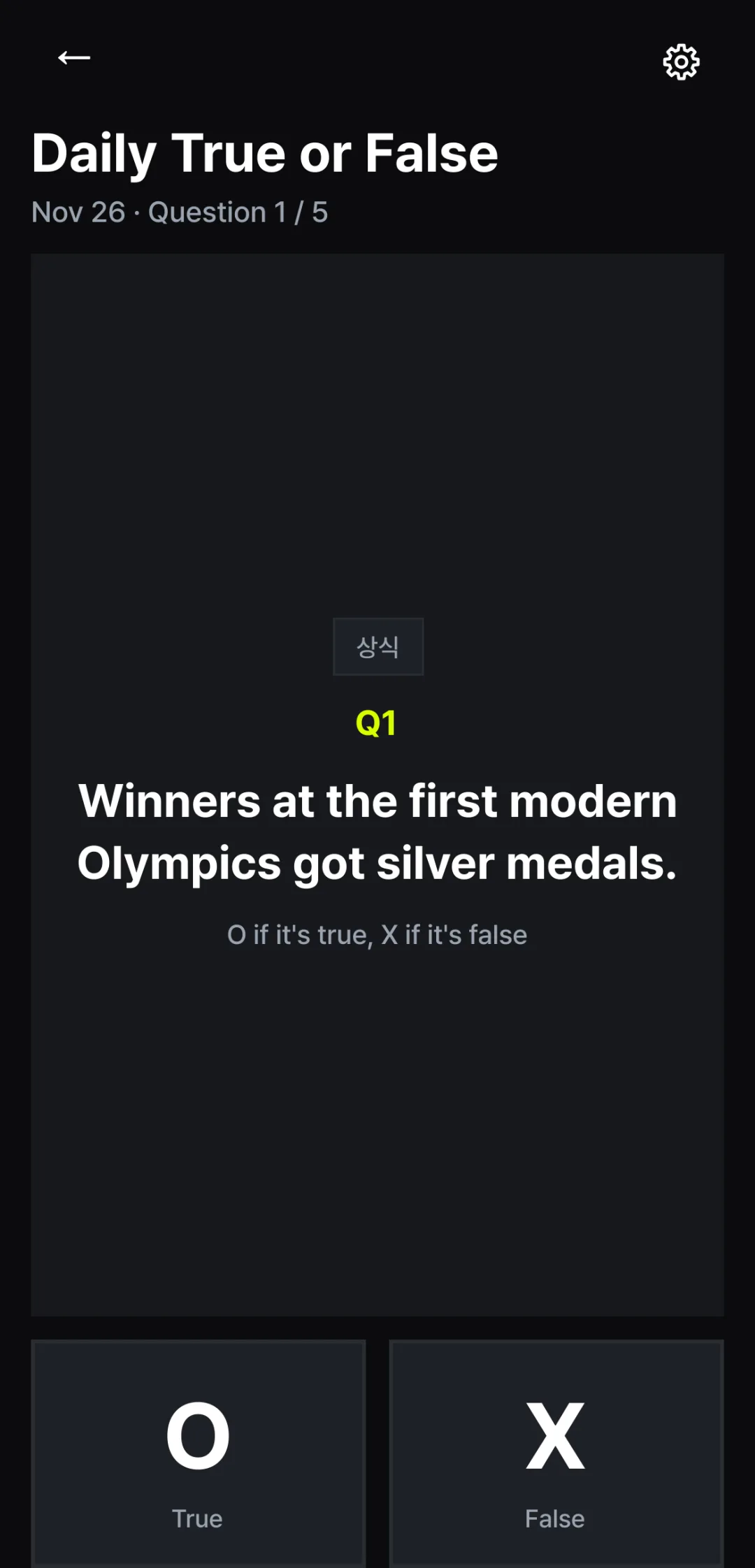
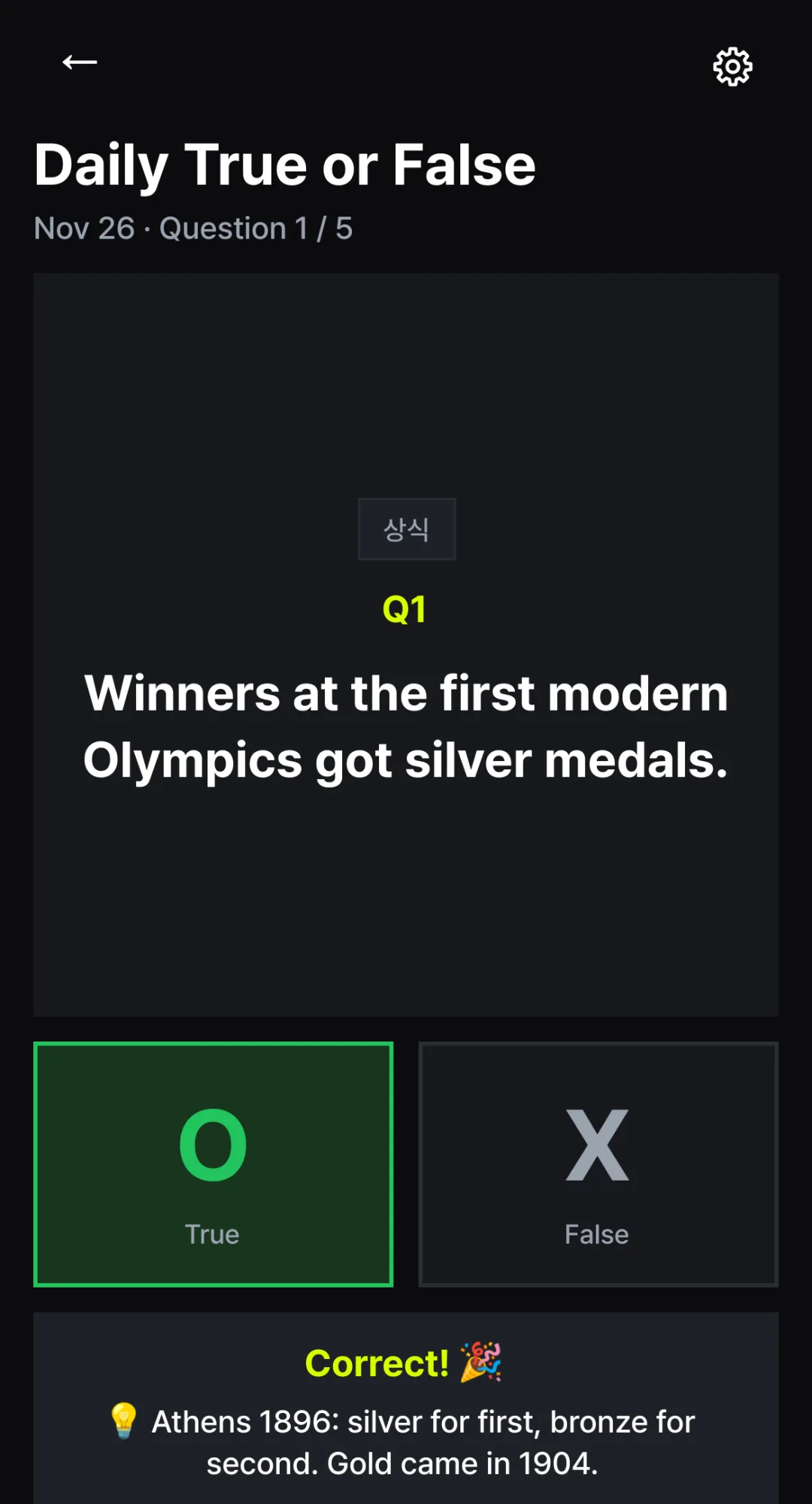
Five statements a day is about one coffee’s worth of true or false. The ▶ button at the top of this page opens PlaySnack’s Daily True or False from a single link, and every fresh statement comes with its one-line why.
Posts that feature this game
- Christmas Games for Grandparents and Kids: 10 Ideas10 Christmas games three generations can play in the living room, with age and movement notes, how to mix teams, a two-hour run sheet and safety tips.
- Riddles & Trivia Quiz: 6 Quick Rounds, What's Your Score?Two true or false questions, two riddles, one reaction test and a would you rather. Play them as you scroll, then see your score out of 100.
FAQ
How many statements should I prepare?
If everyone guessed blindly, half the room would drop each round, so 30 people could be down to one in about five. Real people know things and last longer, so prepare 15 for 30 players plus 5 spares for a final. Past 100 players, 20 to 25 is safe.
What if everyone left gets it wrong?
Nobody goes out. The statement doesn't count and everyone still standing stays in. Announce it at the start so it never turns into an argument.
What do eliminated players do?
Keep playing from their seats. If they track how many they get right, they have a shot at the comeback round or a 'best score among the fallen' prize. With kids, hand them a job: line judge or statement reader.
What if someone says the answer is debatable?
Read your prepared one-line why. If the statement genuinely had two readings, void it and bring back everyone it knocked out. A host's wording mistake shouldn't cost the players.
Does it work with young kids?
Yes, with shorter waits on the bench. Run a comeback every three statements, or skip elimination and just count correct answers. Animals, space and the human body work best because kids can picture them.
Do I need to sign up or download anything?
No. Open the link and it starts right in your phone or desktop browser.
Is it free?
Yes, every game is free.
How many people can play together?
A friends room holds up to 10 people. For a bigger event, email contact@playsnack.app.A friends room holds up to 10 people. For a bigger event, tell us with Contact us.
Does it work in English?
Yes. Even in the same room, each phone shows its own language (English or Korean).