Golf Scoring Terms: Par, Birdie, Bogey, Eagle

“2 birdies, 5 bogeys and one double par lol” — that’s the message your friend just dropped in the group chat. Everyone replies “nice!” and you’re sitting there wondering whether that was a good day or a disaster. By the end of this post, you’ll know exactly how impressed to be.
Part 1 of our Golf Basics series covers scoring terms, because about half of all golf talk is made of these words.
Everything starts with par
Par is the number of strokes a skilled golfer is expected to need on a hole. Depending on length, almost every hole is a par 3, par 4 or par 5, and the most common total for an 18-hole course is par 72 (some courses are 70 or 71).
So every scoring word simply tells you how far under or over par you were. The raw number matters less than the difference from par.
The scoring terms in one table
| Term | vs par | On a par 4 | Scorecard mark |
|---|---|---|---|
| Albatross (double eagle) | -3 | 1 | — |
| Eagle | -2 | 2 | double circle ◎ |
| Birdie | -1 | 3 | circle ○ |
| Par | 0 | 4 | no mark |
| Bogey | +1 | 5 | square □ |
| Double bogey | +2 | 6 | double square |
| Triple bogey | +3 | 7 | — |
| Double par | twice par | 8 | — |
Circles are good news, squares are bad news. Remember that and a TV scorecard reads itself.
A hole-in-one has a second name
A hole-in-one (or ace) is when your tee shot goes straight in the cup. On the card it’s still scored against par: an ace on a par 3 is an eagle (-2), and on a par 4 it’s an albatross (-3).
Birdie, eagle, albatross: why all the birds?
The popular story is that “bird” was late-1800s American slang for something excellent, which gave us the birdie. Better scores got bigger birds: the eagle, then the albatross. The bigger the bird, the rarer the score.
Talking about a whole round
Your total for the day is measured against par too.
- Even par: the same as the course’s par. A 72 on a par-72 course.
- Under par: fewer strokes than par. A 70 is “two under”, written -2.
- Over par: more strokes than par. An 85 is “13 over”, written +13.
That’s why pro leaderboards are full of numbers like -10 and -8. Lower is better.
So, was your friend’s day any good?
Say it was a par-72 course. Two birdies: -2. Five bogeys: +5. If the double par came on a par 4, that’s an 8, so +4. Pars everywhere else makes it +7, a 79. Breaking 80 is a respectable day, so that “nice!” was well earned.
Handicaps: the number that evens things out
A handicap lets golfers of different abilities compete fairly. Under the World Handicap System (WHS), used by most countries since 2020, it works like this:
- Each round becomes a score differential, adjusted for how hard the course is (its Course Rating and Slope Rating).
- Average the best 8 of your most recent 20 differentials and you get your Handicap Index.
- The highest possible Handicap Index is 54.0.
- Before a round, the index is converted into a Course Handicap for the course you’re actually playing.
- In a match or a bet, players then compare net scores: gross score minus course handicap.
Among friends, people often keep it simpler and call “average score minus par” their handicap. That’s where these labels come from:
- Bogey golfer: about a bogey a hole, so around 90 for 18 holes (a handicap near 18).
- Single-digit handicapper: anyone whose handicap is 9 or lower.
- Scratch golfer: a handicap of zero, playing to par.
Could you keep up with the group chat now?
- Four strokes on a par 5? → Birdie
- Five strokes on a par 3? → Double bogey
- 75 on a par-72 course? → Three over (+3)
- A square on the scorecard? → Bogey
Four out of four? Then next time, you’re the one sending “nice!” first.
Tonight’s Round
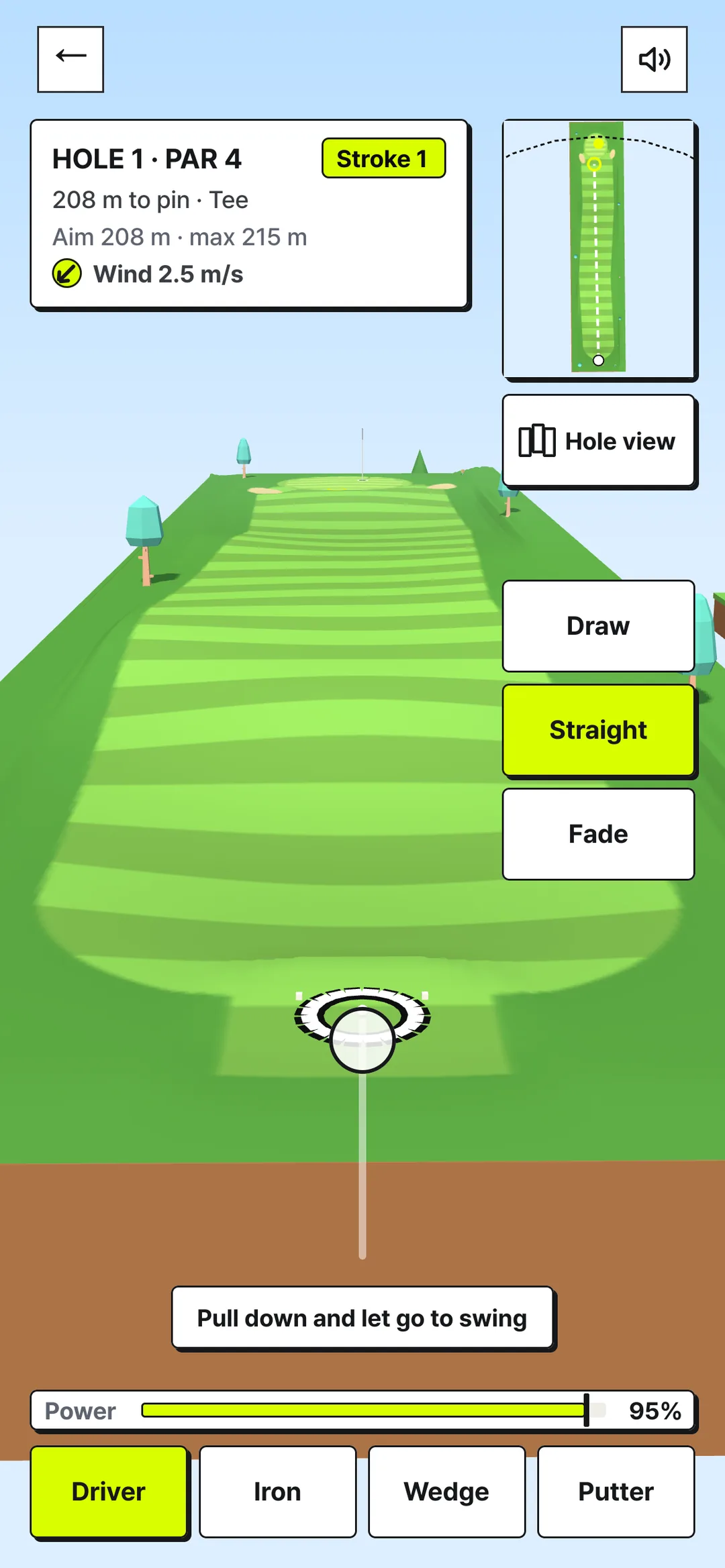
The fastest way to make these words stick is to fill in a scorecard yourself. PlaySnack’s Golf is 3D golf at Cloud Island CC, a made-up club floating above the clouds. Pick the Lake or Valley nine or a full 18 (par 72), and when you finish, your scorecard counts up your birdies, pars and bogeys. It opens straight from a link, nothing to install.
Golf
▶ Play nowFAQ
What's the difference between a birdie and a bogey?
A birdie is one stroke under par (-1) and a bogey is one stroke over (+1). On a par 4, a birdie is a 3 and a bogey is a 5.
What do you call a hole-in-one on a par 3?
It's two under par, so it goes on the card as an eagle. A hole-in-one on a par 4 is three under: an albatross.
How is a handicap worked out?
Under the World Handicap System, your Handicap Index is the average of the best 8 score differentials from your most recent 20 rounds, up to a maximum of 54.0. For a round, it's converted into a Course Handicap for the course you're playing.

