What's the Average Reaction Time? How to Test Yours

Short answer first: tapping when you see a screen change is commonly said to take about 200 to 250 milliseconds, a fifth to a quarter of a second. So why does a phone test sometimes land in the 250 to 300 ms range and leave you wondering if you’re slow? Usually you aren’t. Extra time sneaks into the measurement.
Getting a feel for milliseconds
Reaction time is measured in ms, thousandths of a second. Smaller is faster.
| Time | What it compares to |
|---|---|
| 1,000 ms | One second |
| 250 ms | A quarter second, near the commonly quoted average |
| 100 ms | A tenth of a second, the well-known false-start line in sprinting |
| 16.7 ms | One frame on a 60 Hz screen |
| 8.3 ms | One frame on a 120 Hz screen |
In sprint races, moving within a tenth of a second of the gun is famously treated as a false start, on the reasoning that nobody reacts to the sound that fast; they guessed. Reaction games often do the same and throw out a tap that’s too fast to be real.
Why phone tests read slower than the average
A number measured on a phone includes more than your reflexes.
- The screen has to change. On a 60 Hz display each frame lasts 16.7 ms, so there can be a gap between the color changing and you seeing it.
- The touch has to register. Phones take slightly different amounts of time to notice a finger.
- The browser has to process it. Lots of background apps or battery saver mode can slow things a little.
So a few tens of milliseconds between two different phones may be the phones, not the people. To compare with a friend, take turns on the same device.
What changes your own score
Even on the same phone, reaction time moves from day to day. The commonly reported patterns:
- The kind of signal. Reactions to sound are generally said to be a bit quicker than reactions to light, so don’t compare a sound test with a screen test.
- Predictability. If the signal always comes on the same beat, scores get suspiciously fast. Good tests vary the wait every time.
- How you feel. Sleepy or tired usually means slower and less consistent. Your morning and late-night numbers can differ.
- Practice. A few tries in, you know where to tap and what to expect, and most people get quicker. Don’t judge yourself on try one.
How to read your own numbers
Most tests show two numbers, a best and an average, and they answer different questions.
| Number | What it means | Use it for |
|---|---|---|
| Best | One try where focus and luck lined up | Bragging |
| Average | Your typical speed over several tries | Comparing with friends, or with last week’s you |
| Gap between the two | How consistent you are | A big gap means your focus is wandering |
Look at the average only after five or more tries, and leave out any try where you tapped early; a guess isn’t a reaction. When a friend shows off a best, ask for the average. It keeps everyone honest. For grip and technique to get quicker, see the reaction game tips.
Measure it with a ruler, no phone needed
The ruler drop (how to play it is in the reaction game rules) is more than a party trick. It’s a decent measuring tool, because where you catch it tells you the time.
A falling ruler speeds up as it drops, so the distance tells you the time: time = √(2 × distance ÷ 9.8 m/s²).
| Caught at | Reaction time |
|---|---|
| 5 cm (2 in) | about 101 ms |
| 10 cm (4 in) | about 143 ms |
| 15 cm (6 in) | about 175 ms |
| 20 cm (8 in) | about 202 ms |
| 25 cm (10 in) | about 226 ms |
| 30 cm (12 in) | about 247 ms |
The ruler skips screen and touch delay, so it tends to read a bit faster than a phone test. Missed it completely at 30 cm? That only means you were slower than a quarter second this time; the ruler just runs out. The person dropping should vary the wait every time to keep it fair.
Tonight’s Round
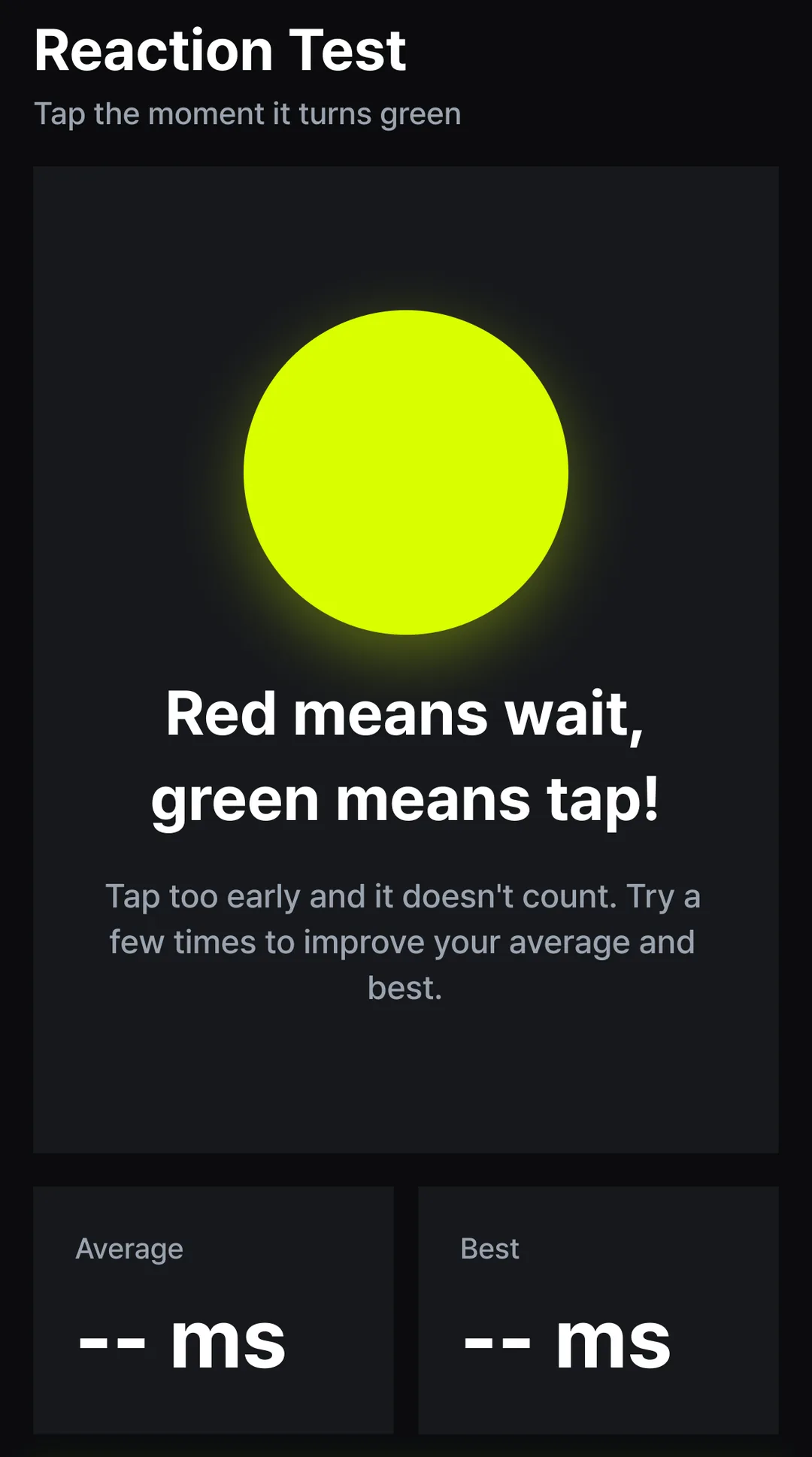
You’ve read the tables; now get your own number. The button below opens PlaySnack’s reaction test: wait on red, tap the moment it turns green, and every try updates your average and best, so you can watch that gap from earlier for yourself.
Reaction Speed
▶ Play nowFAQ
What is a normal reaction time?
For a simple visual task, like tapping when a screen changes color, the figure most often quoted is roughly 200 to 250 ms. Phone and web tests add some screen and touch delay, so they usually read a little slower than that.
Why is my time different every try?
Focus, where your finger is, and how long you waited for the signal all nudge a single result by tens of milliseconds. Five or more tries, averaged, is much closer to your real speed.
Is it fair to compare with friends?
It's fairest on the same phone, taking turns, because that removes the device from the comparison. On different phones, a gap of a few tens of milliseconds can come from the hardware.

